

SPECIAL BLOG
In Celebration of the Jubilee Year 2025 – Fr. Richard has written about Hope.
An Essay on Hope
May the God of hope fill you with all joy and peace
in believing, so that you may abound in hope. Ro. 15:13
Hope springs eternal in the human breast: Man never is. But
always to be blest. Alexander Pope
When Pope Francis opened the holy door in Saint Peter’s Basilica on December 24, he inaugurated 2025 a jubilee year. Centered on the theme of hope, this is the 27th ordinary jubilee in the history of the Catholic Church since the year 1300. To understand the significance of the jubilee and its seven centuries old tradition in the Catholic Church, it is necessary first to recall its biblical origins. Pope Francis urged all believers to be “signs of hope” to anyone in need in anyway possible. Moreover, 2025 is the 1700th anniversary of the Nicene Creed of 325AD. As Pope Francis wished to travel to Nicaea sometime this spring, he had already expressed hope that all Christians might reach an agreement on a common date to celebrate Easter. Meanwhile, the Pope’s anticipated agenda for the jubilee sought to extend the right hand of fellowship to all those who epitomize the virtues of faith, hope, love.
As a way of promoting a year of hope, the Pope authorized the bishops around the world to designate holy places as sites to visit during the jubilee year. As sacred sites are holy to the Lord, many shrines and basilicas will be places to visit. Furthermore, Our Lady of Fatima Shrine / Basilica is one of the chosen places to be a place to visit and not only to visit, but to exercise a personal, faithful witness to the sacred virtue of hope.
Of the three theological virtues, hope is perhaps the most frequently misunderstood. Think of hope simply as a positive expectation of a desired outcome or expected anticipation. Aside from the mundane experience of hope, the virtue of theological hope invites us to place our trust fully in Christ and the fulfillment of his promises. Indeed, this hope is something both anticipated and promised as the church calls us to something greater. In other words, hope is the consequence of justification: “We boast in our hope sharing the glory of God (Ro 5,1). Thus, hope is a fulfilled blessing, even though we had fallen short of the glorious destiny that God once intended for us (Ro 3,23), and yet we now find ourselves confidently expecting it. Through hope, grace abounds with us sinners because Christ through death has borne the consequences of our sins and has thus reconciled us to God. Hope is clear evidence that God does not need to be reconciled to us; for it is we who are estranged and need to be reconciled to God who is our true righteousness.
To understand hope as being fulfilled in Christ, we are enjoined to have faith in God, bolstered by love as an ongoing participation in his present life as the risen Lord.
The etymology of the word hope is both a study of its origins and the way in which its meaning has changed throughout history. Therefore, understanding the theological meaning of hope and its historical development are paramount to our awareness and appreciation of expectation as a core element of our religious trust in God’s providence. Moreover, the presence of hope in sacred scripture seems to suggest that with faith and in love, humanity can approach God with optimistic trust: “hope springs eternal in the human breast”, and this encourages human nature always to find a fresh course for optimism in a world that is very much in need of a hoped for trust.
Both as a religious principle and a holy virtue in the Bible as our sacred scripture, hope occurs frequently about 150 times in the OT, more or less depending on the version and about 80 times in the NT. Subsequently, hope looms large in scripture – ‘yachal, tohelet (Hebrew), elpis (Greek) and spes (Latin). And so, although hope appears often in the OT, it only appears 80 times in the NT, mostly in the epistles and Revelation. And yet there are two occasions when hope does appear in the gospels: namely Mt 12,21 (in a reference from Isaiah, and only once in the Fourth Gospel, Jn 5,45, “It is Moses who accuses you, on whom you set your hope.” This statement of Jesus is a judgment based on human pride and a denial of the love of God in Christ, the son who was sent to save. In other words, hope springs forth from Jesus’ special relation to God, and not on the law. We are all under judgment, but with faith we are given the gift of hope, and we are liberated in Christ through God’s unequivocal love and the occasion of hope, our redemption from sin.
Although the word hope is not common in the gospels, it is nevertheless implicit as a theological virtue in the proclamation of the “good news.” What has been preached, i.e. the apostolic kerygma that is committed to written form in the gospel of Mark, the first written “gospel”, thus becomes a work that the author invented as a literary genre. Most sacred scripture is the literary production of a believing community. Mark’s gospel as a written document aims at informing the reader, as well as building up the community’s faith. In story form the gospel writers intentionally meant to tell a narrative to make a difference in the reader’s life. And in Mark’s case the written expression of the gospel demonstrates the immediacy of urgently revealing the story’s narration. The author uses the word “immediately” 42 times to convey a vivid concrete image of a very active Jesus. All of the gospels are intended to express a point of view to a special reading public in order to minister to their faith. The good news that they have to tell is meant to make an impact in the reader’s / hearer’s life both through narrative and proclamation. And so, implicitly in the gospels is hope – a virtue effectively illustrated in the remaining NT writings.
The Theological Virtue of Hope in the Bible
Undoubtedly, the virtue of hope figures large in sacred scripture along with the significance of faith and love. The complete Bible includes 72 books – OT, Duetero-Canonical, and NT. As a compendium of diverse writings, the Bible is a powerful exposition of the redemptive activity of God, a heilsgeschicte that is a sacred story revealing the action of God and his chosen people. The content of the Bible may come across as a challenge to understand and interpret, yet studying sacred scripture closely shows a golden thread of thematic development, from Genesis to Revelation. Moreover, the Bible appeared first via an oral transmission and then in written form. The OT was written in Hebrew and Aramaic, the duetero (second canon) probably originally in Hebrew and Aramaic and some Greek and then available in Greek. The NT was written in the Koiné Greek of the Hellenistic world. Today, there are literally hundreds of translated versions of sacred scripture largely because the contents of the Bible begs to be available. Furthermore, there are excellent English language versions at our disposal.
Sacred scripture is clearly a heilsgeschicte, A sacred story about the activity of God as an omniscient, omnipresent Lord of life who relates to his chosen people. The Bible as a diverse anthology reveals a golden thread of thematic meaning. For example, think of the letter C as a way that the Bible holds together faith, hope, love. To begin – In the beginning, God created the universe = creation.
Next, the call of Abraham whom God chose to be the father of many = election,
Next, the covenant is given to the now named Abraham and his descendants,
Next, is the confederacy Of the 12 tribes of Israel, the faithful remnant = the Church,
Next, is the coming of Christ, the prophesied Redeemer, Emmanuel, God-with-us,
And finally the consummation = the Kingdom of Heaven.
Thus, the letter C becomes a leitmotif, a recurring idea, the expository underscoring of salvation history that is God’s plan for us.
Focusing our attention and piety this Jubilee Year 2025 makes sense for us to be attentive to hope as the middle principle bonding faith to agapē/love.
The theological virtues of faith, hope, and love are not an article of belief, imagined out of context in a vacuum, but rather a religious precept that biblical scholars use to assist and help our understanding of the pivotal importance of hope. For example, Sitz im Leben is a German phrase roughly translated to mean “a situation in life.” It stands for the context by which a text or object has been created and its function and purpose in time. Sitz im Leben / setting in life contextualizes the meaning of a particular era or event, thereby taking it into the lived situation in order to allow a reasonable contextual interpretation.
Therefore, it is good, necessary, and proper, to appreciate salvation history by means of Sitz im Leben. Understanding the “situation in life” in the OT is somewhat conveyed metaphorically. And so it is expedient to know and recognize the golden thread sustained by the letter C.
The significance of Sitz im Leben is very much illustrated in the NT because of its connection to the Resurrection – our hope in Jesus. The gospels are all orientated toward the Jesus – resurrection event. And the remaining NT writings are predicated upon the pivotal importance of resurrection and the associative importance of the risen Christ. This ties into the virtue of hope. After all, we are an Easter people; and ours is a resurrection faith filled with hope.
There are two witnesses to the resurrection hope that the NT writers promote as their kerygma/proclamation. First, there is the empty tomb witness and second there are the post resurrection appearances of Jesus. It is the second of these witnesses where Sitz im Leben is so important, for indeed it concretizes the inherent hope that Jesus of Nazareth, the crucified Lord was actually seen and perceived as the physical epitome of hope. We have seen the Lord becomes a clarion call to be a people of hope in God’s sacred plan for us, his created ones. The Risen Christ, truly present to us is our hope as we proclaim this and believe this. In the beginning God… I am the Alpha and the Omega. The Sitz im Leben of our faith recurs as a leitmotif that begins and ends with God, who in Christ is our hope for all humanity. Fiat, may it always be so.
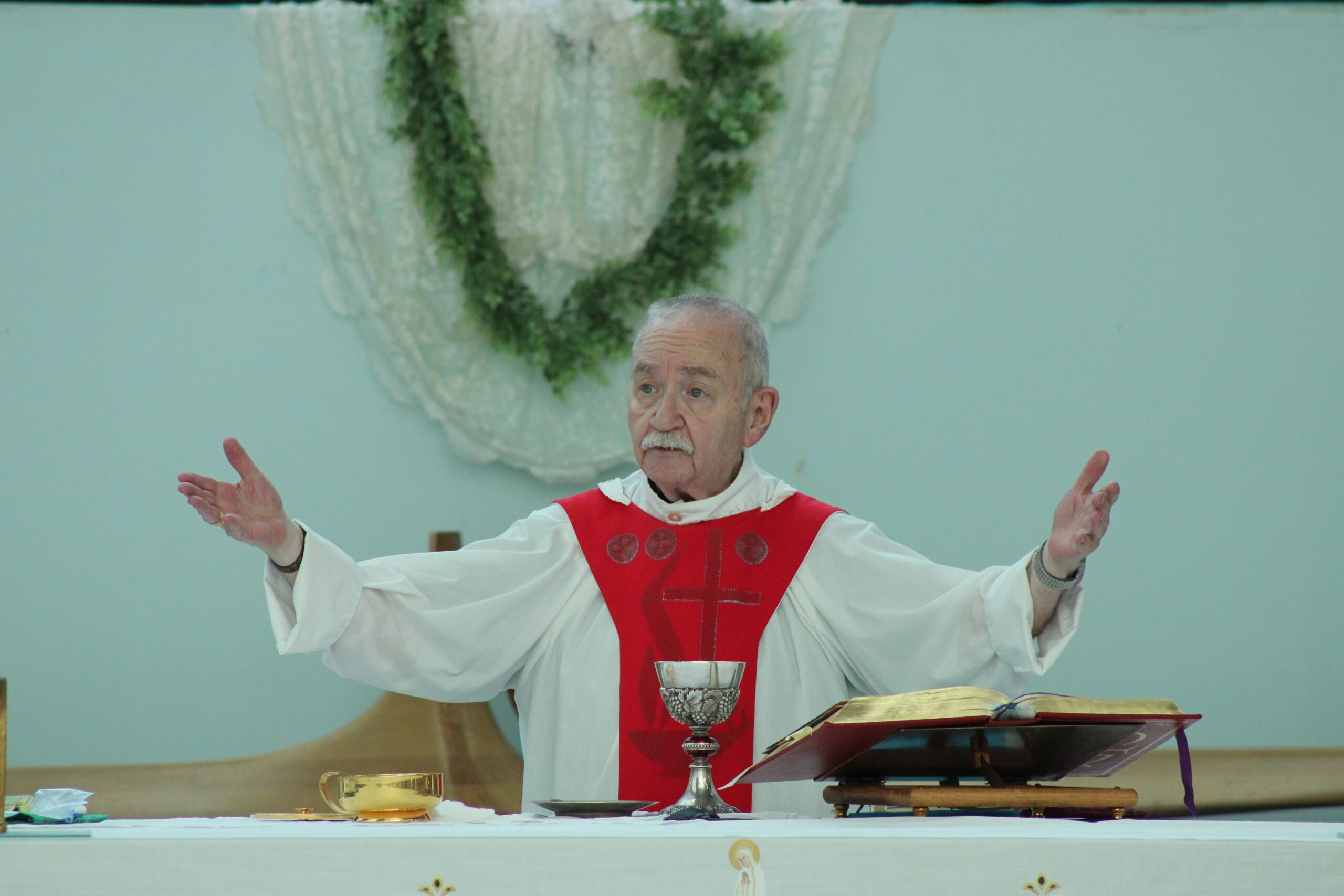
Fr. Richard Delzingaro, CRSP
Jubilee Year – May 2025