
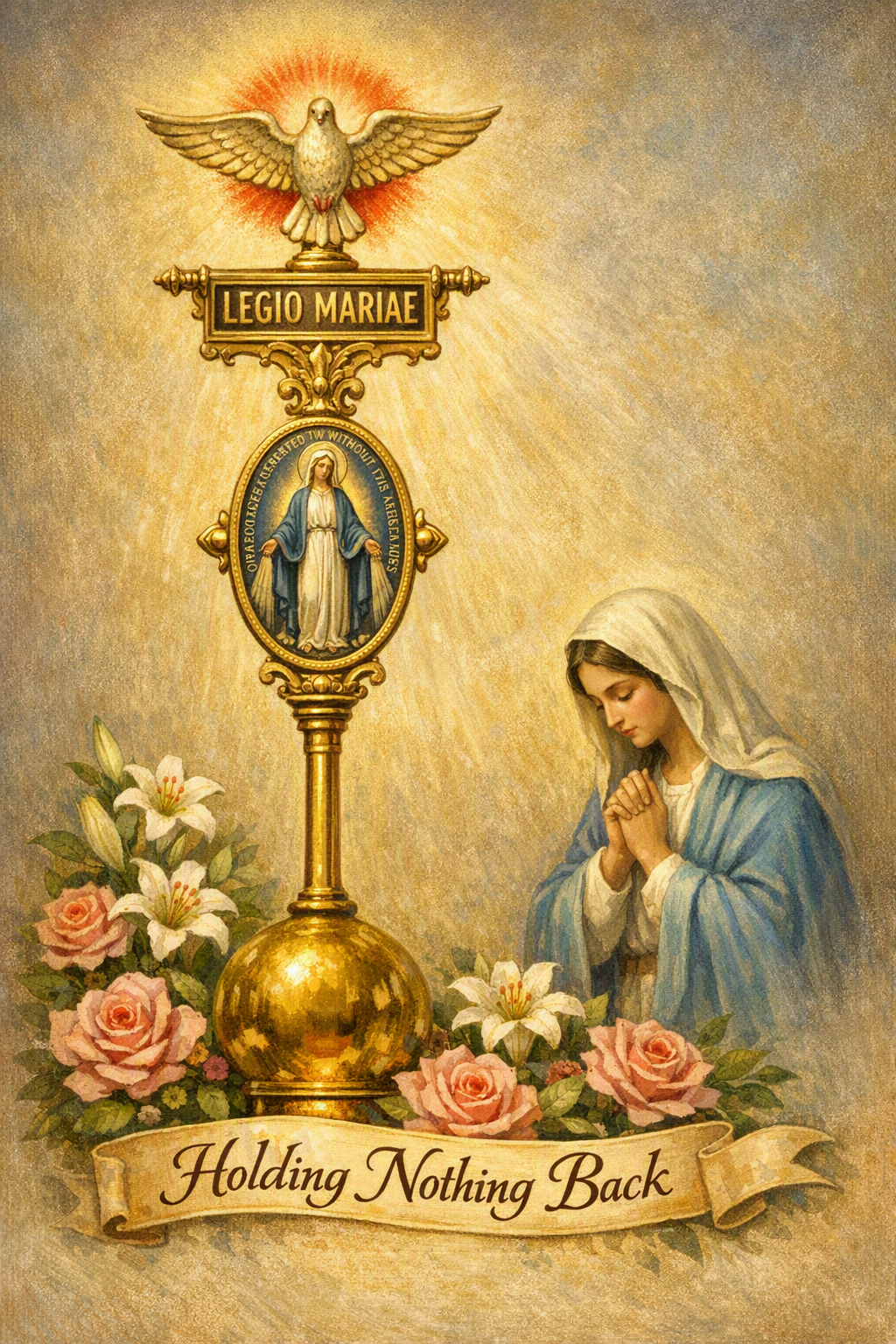
The image used in this essay was created using Google AI Image Creator.
From the heart of a:
LEGION OF MARY AUXILIARY MEMBER
A meditation, phrase by phrase, on two prayers to Our Lady:
“O Lord Jesus Christ, our mediator with the Father…”
and the Sub Tuum Praesidium, “We fly to your patronage…”
James Dacey, Jr OFS🌹 AKA – Rosary Man Jim
Freely given. Freely shared.
Part One – Our Mediatrix
Chapter One: Our Mediator with the Father
“O Lord Jesus Christ, our mediator with the Father…”
There is an order to this prayer, and the order matters. Before Mary is named at all, Christ is named first, our mediator with the Father. Nothing that follows is allowed to blur that. Whatever we come to understand about Mary’s place, it begins here, at His feet, not beside them.
And then the second line arrives, quiet and enormous: pleased to appoint. Not “some have come to believe.” or “tradition has grown to hold.” Appointed! This was not sentiment layered on by centuries of devoted hearts, though those hearts have certainly loved her well. This was a choice made by Christ Himself; His mother becomes our mother; His intercessor becomes ours too.
The Church has held onto language like this a long time. The title itself, Mary as one who mediates by intercession, always beneath and never alongside Christ’s own unique mediation, has been used by saints for over a thousand years, growing through the Middle Ages and reaching real height in the writings of St. Louis de Montfort himself.¹ It’s worth saying plainly here, because de Montfort is the very soil the Legion of Mary grew out of. Frank Duff read True Devotion to Mary and said it threw his whole life into Marian channels it never left again.² Whatever we build in these pages, we are standing where he stood first.
I’ll add one honest note, because these reflections should never pretend the Church stopped speaking after the eighteenth century. In November of 2025, the Vatican’s doctrinal office cautioned that titles like Mediatrix carry limits and encouraged the faithful to lean more simply on “Mother of God.”³ I don’t share that to undercut anything de Montfort taught, or anything the Legion has prayed for over a hundred years. I share it because faithfulness means holding what the Church has always held and also listening when she asks us to hold it carefully. The heart of the prayer doesn’t move an inch either way: Christ appointed His mother to be ours. However precisely that gets worded from one century to the next, that has not changed and will not.
What moves me most in this line, though, isn’t the doctrine. It’s the tenderness folded inside it. Your mother, to be our mother also. Not a title bestowed from a distance, a relationship extended. I find myself talking to her the way I’d talk to someone I trust with everything, the way you’d hand something to your own mother without needing to explain why you’re handing it over. I ask her, plainly, to carry things to her Son. Not instead of going to Him myself, alongside that. And I believe, in the way you believe something you’ve lived rather than something you’ve only been told, that it brings her joy to do it. That she wants nothing more than for her Son to see His mother still gathering up the prayers of His children and placing them in His hands.
That is what “mediatrix” means when it stops being a word in a catechism and becomes a woman you actually talk to.
And this is where the Rosary belongs in this chapter, because it can’t wait until later, the Rosary is this appointment lived out, decade by decade. Every Hail Mary is small proof that we believe what this prayer says: that we can bring Him our necessities through her hands, and she will carry them faithfully. The Rosary isn’t a separate devotion sitting next to this doctrine. It’s the doctrine in motion. It’s how “our mediatrix with You” stops being theology and becomes a daily habit of the heart.
None of us will ever love her the way she deserves. I know that plainly, I could say I’d give everything the way she gave everything but living it and meaning it are not the same thing, and I know the distance between the two in my own life. Most of us carry families, work, distractions, weaknesses she never carried. But I think that’s precisely why Jesus appointed her as He did. He didn’t ask us to become her. He gave us a mother who already stands where we cannot yet stand, so that our prayers could still reach Him, carried, not perfected.
We come to Him seeking His favors. And He has arranged, out of love for both of us, that we would rejoice to receive them through her.
¹ Wikipedia, “Mediatrix” — on the historical development of the title and its height in de Montfort’s writings.
² San Francisco Senatus, “True Devotion to Mary” — on Frank Duff’s own account of the book’s lasting effect on his life.
³ Wikipedia, “Mediatrix of all graces” — on the November 2025 statement from the Dicastery for the Doctrine of the Faith.
Chapter Two: To Be Our Mother Also
“…pleased to appoint the Most Blessed Virgin, Your mother, to be our mother also…”
There is a moment on Calvary where Christ, already dying, stops to make an appointment. Not a metaphor, or a devotional flourish added by later centuries. John records it as something said, out loud, from the cross: “Woman, behold your son.” Then, to the disciple standing beside her: “Behold, your mother.” Two commands, spoken in the same breath, in the same dying voice.¹
The Church has never read that moment as a private arrangement for John’s care. From the earliest centuries, the beloved disciple has been understood to stand for every disciple, for the whole Church, present at the foot of the cross in his one small body.² Which means the words were never only “behold your mother, John.” They were “behold your mother,” full stop, aimed straight through him at everyone who would ever kneel thereafter. Pope Paul VI would later make this explicit and official in 1964, naming Mary “Mother of the Church”, but he wasn’t inventing anything. He was simply saying out loud what Christians had already believed since Calvary itself.³
What strikes me most, reading this scripture again, is what it is not. It is not phrased as an invitation, we’re free to decline. “Behold your mother” is not “if you’d like, you may consider her your mother.” It is a statement of fact, spoken by the only person with the authority to make it one.⁴ Christ doesn’t ask our permission to give us His mother. He simply gives her the way a father presses something valuable into his child’s hands and closes their fingers around it before letting go.
And I think that’s part of why this particular gift lands so differently than any other gift He could have given from the cross. A mother is not a possession to be handed over like an object. A mother is a whole way of being loved, patient, attentive, present even when nothing is asked of her directly. To give us His own mother was to give us access to exactly that kind of love, aimed now at every one of us the way it was once aimed only at Him.
I think of my own mother often when I sit with this phrase, though I won’t turn her into the subject of these pages, that isn’t what this document is for. But I will say this much: the same woman who first put me in the path of Christ, all those decades ago, without meaning to do anything more than keep herself company one evening, still kneels with me now, saying the same prayers, moving through the same mysteries. There is something in that overlap, one mother’s quiet, unglamorous faithfulness echoing another mother’s, that makes “to be our mother also” less like doctrine and more like something I have simply watched happen, more than once, in my own life.
This is where the Rosary carries the weight again, because the Rosary is where “behold your mother” stops being a single sentence spoken two thousand years ago and becomes something a person actually does, decade after decade, for the rest of their life. Every time the beads move, we are accepting the gift all over again, not once, at the foot of a cross we never stood beneath ourselves, but nightly, in whatever kitchen or car or quiet room we happen to be praying in. The Rosary is how “our mother also” gets lived rather than merely believed.
None of us chose this gift the way we choose most things in life. It was simply given, while Christ still had breath enough to give it, before He had none left at all. I don’t think a gift like that asks much of us except one thing: to actually receive it. To let her be, in truth and not only in title, exactly what He said she would be.
¹ John 19:26–27.
² EWTN, “To the Disciple He Said, Behold Your Mother,” on the patristic and traditional understanding of the beloved disciple as representative of all believers.
³ Journeys of Faith, “Mary Mother of the Church,” on Pope Paul VI’s 1964 proclamation of the title Mater Ecclesiae.
⁴ Corpus Christi Catholic Church, “Marian Dogmas & Doctrine — Part 5,” on the theological weight of “Behold your mother” as a statement of fact rather than invitation.
Chapter Three: Our Mediatrix with You
“…our mediatrix with You…”
There’s a scene at the Wedding in Cana that I think explains this phrase better than any theological definition could. The wine runs out, a small, human, almost embarrassing problem, and Mary notices before anyone else seems to. She doesn’t fix it herself. She doesn’t perform a miracle of her own. She simply turns to her Son and says, “They have no wine.” Then, without waiting for His answer, she turns to the servants and says the only thing she ever really says to any of us: “Do whatever he tells you.”¹
That’s the whole shape of her mediation in one small scene. She notices what we need. She brings it to Him. And then she points every single time, without exception, straight back to Him.
The Church has never treated this as some kind of parallel power running alongside Christ’s own. Vatican II was careful and deliberate about this in its own teaching on Mary, stating plainly that her maternal role “in no way obscures or diminishes” His unique mediation, but rather shows what that mediation can do.² Her intercession isn’t a second source of grace standing beside His. It flows out of His, entirely dependent on it, carrying no power of its own apart from what He has already given her.³ Pope St. Pius X once used an image for this that has stayed with me since I first read it: Mary as the neck connecting the head of the body to its members, necessary, real, and yet every bit of what flows through her comes from the head, not from herself.⁴
I asked myself, writing this chapter, what that actually looks like from the inside, not the theology of it, but the picture I hold in my own heart when I ask her to carry something to her Son. And what came to me wasn’t stately or formal at all. It was the image of a child. A small child who has found something, a leaf, a stone, some little unremarkable treasure, and goes running, breathless and thrilled, straight to a parent. Look what I found. Look how beautiful this is. Not embarrassed to be excited over something small. Not calculating whether it’s worth the parent’s time. Just pure, unguarded joy in bringing it to the one who will delight in it too.
I think that’s closer to the truth of Mary’s mediation than most of us imagine. She is, after all, herself a creature, the highest of all creatures, but a creature still, redeemed like the rest of us, “the first of the redeemed,” as the Church has always taught.⁵ When she brings our prayers to her Son, I don’t picture solemnity. I picture something closer to delight, a mother showing her Son what His children have brought Him, the way any parent lights up seeing their child’s joy reflected back at them from someone they both love. Look at these children. Look what they’re asking of You. I’m bringing it to You. And I believe that the way you believe something lived rather than something merely taught, that Christ receives it exactly the way any son receives what his mother hands him, gladly, tenderly, because it comes from her hands.
This is also exactly why the Rosary works the way it does. Every decade is really just this same scene at Cana, repeated: noticing a need, bringing it to her, trusting her to carry it further than we could carry it ourselves. We’re not praying to a second god beside the first. We’re handing a child’s small, found treasure to a mother who knows exactly whose delighted attention to bring it to.
Nothing about this diminishes Jesus. If anything, Cana proves the opposite, the servants filled the jars, but it was His word alone that turned water into wine. Mary asked. She pointed. He acted. That order never once reversed itself, at Cana or anywhere else, and it won’t reverse itself in this document either. She remains, always, exactly what this prayer calls her: our mediatrix with Him. Never instead. Only ever with.
¹ John 2:1–5.
² Lumen Gentium, n. 60, Second Vatican Council.
³ Lumen Gentium, n. 60; Pope John Paul II, Redemptoris Mater, n. 38, and General Audience of October 1, 1997.
⁴ Pope St. Pius X, Ad Diem Illum Laetissimum, n. 13, on Mary as the “neck” joining the Head to the mystical body.
⁵ Catholic Culture, “Mary Cooperates in God’s Saving Plan,” citing Pius IX’s Ineffabilis Deus (DS 2803) on Mary as the first of the redeemed.
Chapter Four: That They May Rejoice to Receive All of Them Through Her
“…that whoever comes to You seeking Your favors may rejoice to receive all of them through her.”
All of them. Not the reasonable requests. Not the ones dignified enough to bring before God formally. All of them, the small, the daily, the half-embarrassed, asking for peace when nothing dramatic is even wrong, right alongside the largest and most desperate prayers a person will ever pray in a lifetime. This phrase doesn’t rank our petitions before handing them to her. It simply says: whatever you’re seeking, bring it, and rejoice that it passes through her hands on its way to His.
I think most of us, if we’re honest, quietly sort our prayers before we ever say them. Some feel worthy of God’s full attention. Others feel too small, too ordinary, almost embarrassing to bring before the Creator of the universe, asking for peace on an unremarkable evening, when nothing is actually wrong except the ordinary weight of being alive. But that instinct to sort, to filter what’s “worth” bringing to Him, isn’t something Scripture or the Church ever asks of us. It’s something we impose on ourselves. This prayer erases that sorting entirely. All of them. Even the ones that feel too small to say out loud.
And then there’s the other kind of prayer, the kind that doesn’t feel small at all, the kind that comes from the deepest place a person has. I think of the prayers prayed for someone gravely ill, prayed with everything a heart has, prayed to both Jesus and to Mary, begging her to carry the request the way only a mother could. And I think of what happens when that prayer isn’t answered the way it was asked, when healing doesn’t come, when the person you loved is brought home to God instead of kept here with you. That is the hardest test this phrase will ever face in a person’s life, because it asks us to still believe, in that moment, that the prayer really was received through her hands, and really was brought before Him, even though the answer wasn’t the one we begged for.
I don’t think this prayer promises that every request comes back the way we hoped. I think it promises something quieter and, in the end, sturdier: that nothing we bring to her is ever lost, dismissed, or too small for her attention. Some prayers return to us as exactly what we asked for. Others return as something we didn’t ask for and wouldn’t have chosen, but that God, in a wisdom we can’t always see from inside our own grief, judged to be the truer mercy. Even that, even the hardest kind of “no” a person can receive, still passes through her hands on its way from us to Him. She doesn’t only carry the prayers that end in comfort. She carries the ones that end in loss, too, and stands beside us in exactly that kind of sorrow, because she stood at the foot of a cross and watched her own Son’s life end in a way she never would have chosen either.
This is part of what the Rosary quietly teaches a person over years of praying it, not just how to ask, but how to keep asking, decade after decade, even though the prayers that were never answered the way we wanted. The sorrowful mysteries exist for exactly this reason. Mary herself walked through unanswered prayer, through watching what she loved most suffer and die, and she didn’t stop being mediatrix in that moment. If anything, that’s where her mediation shows itself most completely, not only carrying our requests to Him, but staying beside us in the ones He answers with something other than what we asked for.
Rejoice to receive all of them through her. Even now, even after prayers that ended in a grief I wouldn’t have chosen, I find I still believe that phrase. Not because every answer felt like a gift in the moment it arrived. But because I’ve come to trust that nothing offered through her hands is ever wasted, misplaced, or unheard, including the prayers whose answer was simply: not this, but Me, and I am enough.
Part Two – Sub Tuum Praesidium
Chapter Five: We Fly to Your Patronage
“We fly to your patronage…”
Flight is a physical word before it’s a spiritual one. Nobody flies from danger by staying still and thinking calmly about their options. The body moves first, hands reach, feet run, arms close around whatever is nearest and solid. This prayer, ancient as it is, was never meant to describe a calm, seated kind of asking. It describes the body’s own instinct for shelter, translated into words.
That’s worth remembering, because this prayer is older than almost anything else we pray. Fragments of it have been traced back to the third or fourth century, making it very likely the oldest surviving prayer addressed to Mary that the Church still prays today.¹ Christians were already fleeing to her, in this exact language, while the Church was still young enough to be persecuted for existing at all. Whatever “flight” meant to them, it wasn’t poetic. It was often literal survival, and Mary was who they ran to.
I think that’s part of why this prayer has never needed updating. The instinct it describes hasn’t changed in seventeen hundred years, even if the dangers have. And I notice it in my own body before I notice it in my own words. When something frightens me or simply overwhelms me the way ordinary life sometimes does, my hands move before my mind has fully caught up to what’s happening. If it’s Jesus Christ I’m turning to, my hand goes first to a small cross that sits on my desk, one I carried in my pocket for years before that, a real weight in the palm, something solid enough to hold onto when nothing else feels solid. And if it’s her, I’m turning to, my hand goes to the rosary beads themselves. Not a rosary tucked away in a case, kept clean and protected. The beads themselves, worn from use, one of them the very first set I ever made, decades ago, still worn around my neck to this day.
There’s something the Church has always understood about this, that we are not pure spirits, and God did not make us to pray as though we were. We are bodies that believe with our hands as much as with our hearts. A sacramental, an object blessed and set apart, like a rosary or a cross, doesn’t manufacture grace on its own. But it gives the body somewhere to go when the soul is fleeing toward God, so that the flight isn’t only interior and invisible. It becomes something you can grip. Something with weight and texture, worn smoothly by years of exactly this same motion, over and over, in exactly this same kind of need.
I’ve noticed something else, too, thinking about this phrase honestly: the flight looks different depending on where I am. At home, still, unhurried, I reach for the beads themselves and hold them the way you’d hold someone’s hand. On the road, walking or driving, there’s less reaching and more simply speaking, the words come first there, the beads come later, back home, back to stillness. I don’t think that’s a contradiction. I think it’s just what flight actually looks like in an ordinary life, sometimes it’s a physical grip on something solid, and sometimes it’s just turning your voice toward her mid-stride, because you can’t stop moving long enough to hold anything at all. Both are still flight. Both are still “we fly to your patronage,” just wearing different clothes depending on the hour.
This, too, is what the Rosary trains into a person over enough years of praying it. The beads themselves become almost inseparable from the flight itself, not because the plastic or wood or cord carries any power of its own, but because the hand has learned, through thousands of repetitions, that this is where you go when you need her. The object becomes a kind of muscle memory for the soul. Long before the mind has composed a single sentence of prayer, the hand already knows where to reach.
I think that’s exactly what this ancient prayer was describing all along, centuries before any of us were born to say it. Not a formal request, worked out in advance and delivered calmly. A flight, sudden, physical, and instinctive, toward the one place a frightened child has always known to run.
¹ Wikipedia, “Sub tuum praesidium,” on the dating of the earliest known manuscript fragment to the 3rd or 4th century.
Chapter Six: Despise Not Our Prayers in Our Necessities
“…despise not our prayers in our necessities…”
There’s a fear folded quietly into this line, even if the person praying it never says the fear out loud. You don’t ask someone not to despise your prayer unless some small part of you has wondered whether it might be despised, turned away, judged not worth the asking, met with silence because the need wasn’t large enough or the request had already been made too many times before. This prayer doesn’t pretend that fear isn’t there. It simply meets it, head-on, and answers it before the sentence is even finished: despise not. Not “consider,” or “weigh.” Despise not. As if the Church already knew, seventeen centuries ago, exactly what a frightened heart quietly wonders when it finally works up the nerve to ask for something.
I’ve come to understand, writing through this line honestly, that the fear isn’t always what it first appears to be. It isn’t always “will she think this is too small.” Sometimes it’s something quieter and harder to name, a kind of learned reluctance to ask for anything at all. A life built around accepting whatever God allows, without contest, without visible complaint, can make asking itself feel like a small betrayal of that acceptance. If I’ve truly surrendered to His will, some part of the heart reasons, then what business do I have asking Him to change it? Isn’t the asking itself a little bit of resistance dressed up as prayer?
I don’t think that’s actually true, though I understand exactly why the heart arrives there. Christ Himself asked the Father, in the garden, to let the cup pass from Him, and in the very same breath surrendered completely to whatever the Father willed instead.¹ Asking and accepting were never opposites for Him. They were the same prayer, spoken in the same breath, one leaning fully into the other. If the Son of God could ask honestly and still surrender completely, then asking cannot be the flaw I sometimes suspect it is in myself. It may simply be the shape faith takes when it’s honest, not silence dressed up as holiness, but real petition, offered by someone who has already decided, whatever the answer, to accept it with both hands.
Our necessities, not our preferences or our comforts, but our real and honest needs, deserves a second look too. Necessity implies something a person cannot supply for themselves. And I think that’s exactly where the old, quiet feeling of unworthiness tends to creep in, a sense that asking for help admits some kind of insufficiency, some lack a stronger, more faithful person wouldn’t have. But every soul that has ever prayed this line, across seventeen hundred years, was admitting the very same thing. Necessity is not weakness poorly hidden. It’s simply the truth of being a creature rather than the Creator. Mary herself had a necessity once, at Cana, and didn’t hesitate to name it: they have no wine. If she could bring an ordinary, almost embarrassing need before her Son without shame, then perhaps our own quiet needs are allowed the same dignity.
This is one of the gentler gifts of praying the Rosary for years, it slowly retrains a heart that has learned to only accept, never to ask. Decade after decade, a person keeps saying, in effect, pray for us, an open admission of need, repeated so many thousands of times that eventually the shame around it wears thin. The Rosary doesn’t demand grand petitions. It simply keeps the asking alive, small as it may be, so that the heart never fully closes the door on its own necessities out of some misplaced sense of unworthiness.
I don’t think this line promises every necessity will be resolved the way we’d choose. But it promises something I needed to hear stated plainly: the prayer itself, however small, however many times repeated, however sheepishly offered by someone who half-expects to be told his needs don’t matter much, that prayer is never despised. Not by her. Not once.
¹ Luke 22:42, on Christ’s prayer in Gethsemane — asking honestly, then surrendering completely.
Chapter Seven: Ever Deliver Us from All Dangers
“…ever deliver us from all dangers…”
Ever! Not once or for a single crisis and then silence until the next one. Ever, every day, every uncertainty, every stretch of a life that doesn’t come with guarantees. This prayer doesn’t ask for a single rescue. It asks for a whole life carried, danger after danger, for as long as there are dangers left to face.
And there are always dangers, sickness, loss, uncertainty about tomorrow, the ordinary weight of simply being alive in a fallen world. Christ never once promised His followers a life free of storms. He promised something bolder: that we wouldn’t face them alone, and that fear didn’t have to own us while we walked through them. “Do not worry about your life,” He says, pointing to birds that build no barns and still eat, lilies that spin no thread and still wear glory no king ever matched.¹ That’s not a gentle suggestion. It’s a direct challenge to the anxious human heart, stop clenching. I’ve got this.
I’ve tried to build a life on taking that challenge seriously, and I mean literally, not as a nice sentiment I keep at arm’s length. There have been real dangers in my own life, health that failed me more than once, moments where the ground genuinely shifted under my feet without warning. And in every one of those moments, the choice was the same: grip the fear myself, or hand it over to hands bigger than mine. I’ve chosen the second one, over and over, until it’s stopped feeling like a choice at all and started feeling like simply how I live.
That doesn’t mean nothing rattles me. Things do. I’m not made of stone, and I’ve never pretended to be. But I’ve stopped turning those moments into battles, because I’ve learned, through things I actually lived through, not things I imagined, that my own strength was never where the real deliverance came from. The strength came from letting it be carried by Someone who could actually carry it.
That’s the real fire under this line: deliverance doesn’t always look like the danger disappearing. Sometimes it looks like walking straight through the middle of it and coming out the other side still standing, still whole, still trusting, not because the trial was small, but because I wasn’t the one holding it up alone. A person who has never been tested doesn’t know if their trust is real. A person who has been through something and still came out believing, that’s a trust that’s actually been proven, not just professed.
The Rosary trains exactly this kind of steadiness into a soul, bead by bead, over years nobody’s counting. Every decade is a small act of letting go, surrendering the next sixty seconds of worry into hands that don’t need your grip to hold you steady. Do that enough times, for enough years, and something in you stops flinching quite so hard when real danger finally shows up, because you’ve already rehearsed the letting go ten thousand times before the moment that actually mattered arrived.
I don’t carry this trust because nothing has ever gone wrong. I carry it because something has, more than once, and it held anyway. Not because the danger wasn’t real. Because Something bigger than the danger was already there, holding on tighter than I ever could have held on myself.
¹ Matthew 6:25–26.
Chapter Eight: O Glorious and Blessed Virgin
“…O glorious and blessed Virgin.”
After everything this prayer has asked, flight, need, deliverance from danger, it ends somewhere unexpected. Not with a final request or with “and please.” It ends in praise. As if simply naming our fear to her, and trusting her with it, was reason enough to close in wonder rather than worry. The whole prayer moves from we fly to we admire, and that movement matters. Fear brought us running to her. But something about actually arriving there, safe in her attention, turns the heart naturally toward gratitude for who she is, not just what she does.
And who she is, at the center of it, is someone who said yes to something almost impossible to imagine saying yes to. An angel appears to a young woman and asks her, in effect, to surrender every plan she’d ever had for her own life, her hopes, her future, her ordinary human dreams, so that God could enter the world through her body.¹ She wasn’t asked for a donation from her abundance. She was asked for everything, in advance, with no guarantee of what it would cost her. And she said yes anyway, with words so simple they’ve echoed for two thousand years: “Let it be done to me according to your word.”²
That yes is, I think, the real reason this prayer can end in glory rather than fear. Because everything that came before it, every soul that has ever fled to her in danger, every necessity ever whispered in her direction, only reaches her because she said yes first, before any of us existed to need her at all.
I want to be careful and clear about something here, because it matters more than almost anything else in this personal reflection: what I feel toward her is admiration, not adoration. Adoration belongs to Jesus Christ alone, entirely and without exception. But admiration, genuine, deep admiration for a life poured out completely, for a strength that never once needed to announce itself, that I have in abundance. I look at her example when my own life gets hard, and I find something like a soundboard there: proof that tremendous strength was given to her by God in her hardest moments, and so it can be given to me in mine too. Her humility doesn’t make me want to be noticed. If anything, it does the opposite. It makes me want to disappear a little more, so that whatever good comes through anything I do points past me, toward her, and through her, toward Him.
That’s the real shape of “glorious and blessed” as I understand it, not glory that draws attention to itself, but glory that comes entirely from having given everything away. She is glorious precisely because she held nothing back. Blessed precisely because she asked for nothing in return.
This is, in the end, what the Rosary has always been quietly teaching, prayer after prayer, chapter after chapter of this whole in-depth reflection. Every mystery we move through is really just another facet of that first yes, said once and then lived out completely for the rest of her life. To pray the Rosary is to keep returning to that yes, learning from it, hoping in some small way to imitate it, not for anyone to notice, but simply because her example remains, all these centuries later, the truest one there is.
We fled to her in fear. We asked her for our necessities. We begged deliverance from every danger. And here, at the very end, all of that quiets into something simpler than any request: we just admire her. Glorious and blessed Virgin, thank you for saying yes.
¹ Luke 1:26–38.
² Luke 1:38.
APPENDIX: THE TWO PRAYERS IN FULL
The two chapters below present each prayer as one complete meditation, exactly as they were first written before being broken into the phrase-by-phrase chapters above. Each stands alone as its own reading.
Appendix I: Our Mediator, Our Mediatrix
“O Lord Jesus Christ, our mediator with the Father, Who has been pleased to appoint the Most Blessed Virgin, Your mother, to be our mother also, and our mediatrix with You, mercifully grant that whoever comes to You seeking Your favours may rejoice to receive all of them through her. Amen.”
There is an order to this prayer, and the order matters. Before Mary is named at all, Christ is named first, our mediator with the Father. Nothing that follows is allowed to blur that. Whatever we come to understand about Mary’s place, it begins here, at His feet, not beside them.
And then the second line arrives, quiet and enormous: pleased to appoint. Not “some have come to believe.” Not “tradition has grown to hold.” Appointed. This was not sentiment layered on by centuries of devoted hearts, though those hearts have certainly loved her well. This was a choice made by Christ Himself, His mother becomes our mother, His intercessor becomes ours too.
The Church has held onto language like this a long time. The title itself, Mary as one who mediates by intercession, always beneath and never alongside Christ’s own unique mediation, has been used by saints for over a thousand years, growing through the Middle Ages and reaching real height in the writings of St. Louis de Montfort himself.¹ It’s worth saying plainly here, because de Montfort is the very soil the Legion of Mary grew out of. Frank Duff read True Devotion to Mary and said it threw his whole life into Marian channels it never left again.² Whatever we build in these pages, we are standing where he stood first.
I’ll add one honest note, because these reflections should never pretend the Church stopped speaking after the eighteenth century. In November of 2025, the Vatican’s doctrinal office cautioned that titles like Mediatrix carry limits and encouraged the faithful to lean more simply on “Mother of God.”³ I don’t share that to undercut anything de Montfort taught, or anything the Legion has prayed for over a hundred years. I share it because faithfulness means holding what the Church has always held and also listening when she asks us to hold it carefully. The heart of the prayer doesn’t move an inch either way: Christ appointed His mother to be ours. However precisely that gets worded from one century to the next, that has not changed and will not.
What moves me most in this line, though, isn’t the doctrine. It’s the tenderness folded inside it. Your mother, to be our mother also. Not a title bestowed from a distance, a relationship extended. I find myself talking to her the way I’d talk to someone I trust with everything, the way you’d hand something to your own mother without needing to explain why you’re handing it over. I ask her, plainly, to carry things to her Son. Not instead of going to Him myself, alongside that. And I believe, in the way you believe something you’ve lived rather than something you’ve only been told, that it brings her joy to do it. That she wants nothing more than for her Son to see His mother still gathering up the prayers of His children and placing them in His hands.
That is what “mediatrix” means when it stops being a word in a catechism and becomes a woman you actually talk to.
And this is where the Rosary belongs, because it can’t wait until later, the Rosary is this appointment lived out, decade by decade. Every Hail Mary is small proof that we believe what this prayer says: that we can bring Him our necessities through her hands, and she will carry them faithfully. The Rosary isn’t a separate devotion sitting next to this doctrine. It’s the doctrine in motion. It’s how “our mediatrix with You” stops being theology and becomes a daily habit of the heart.
None of us will ever love her the way she deserves. I know that plainly, I could say I’d give everything the way she gave everything but living it and meaning it are not the same thing, and I know the distance between the two in my own life. Most of us carry families, work, distractions, weaknesses she never carried. But I think that’s precisely why Christ appointed her as He did. He didn’t ask us to become her. He gave us a mother who already stands where we cannot yet stand, so that our prayers could still reach Him, carried, not perfected.
We come to Him seeking His favors. And He has arranged, out of love for both of us, that we would rejoice to receive them through her.
¹ Wikipedia, “Mediatrix” — on the historical development of the title and its height in de Montfort’s writings.
² San Francisco Senatus, “True Devotion to Mary” — on Frank Duff’s own account of the book’s lasting effect on his life.
³ Wikipedia, “Mediatrix of all graces” — on the November 2025 statement from the Dicastery for the Doctrine of the Faith.
Appendix II: We Fly to Your Patronage
“We fly to your patronage, O holy Mother of God; despise not our prayers in our necessities, but ever deliver us from all dangers, O glorious and blessed Virgin.”
Notice the verb first. Not “we come.” Not “we ask.” We fly. There’s nothing composed or measured about it — it’s the word you’d use for someone running toward shelter, not strolling toward a request. Whoever first prayed these words wasn’t reciting doctrine. They were fleeing to someone.
And they were fleeing to her a very long time ago. Parts of this prayer have been dated to the third or fourth century, which makes it, by most scholarly reckoning, the oldest known hymn and prayer dedicated to Mary that has come down to us.¹ Before most of the great councils. Before the word “mediatrix” had settled into common use. Before the Rosary as we know it had taken its shape. Christians were already running to her, already calling her by the title that would one day be defined as dogma at Ephesus — Mother of God.² Whatever comes later in the Church’s understanding of Mary only deepens what was already instinct in the third century: when trouble comes, go to her.
Despise not our prayers in our necessities. Not our wishes. Not our preferences. Our necessities — the things we cannot do without, the things that frighten us into praying honestly instead of politely. I find that when I’m most afraid, or most worn down, the prayers get shorter and more true. There’s no performance left in a person who is truly afraid. Just a name, said honestly. Hers, and His.
Ever deliver us from all dangers. All of them — not the manageable ones, not the ones we could probably handle ourselves if we had to. All. That’s a big word to put in a short prayer, and I don’t think the ones who wrote it were being careless. I think they meant it the way a child means it when they call out for their mother in the dark — not calculating which dangers are worth mentioning and which aren’t, just calling out because she is the one who comes.
This is where the Rosary belongs again, because the Rosary is nothing less than this same flight, repeated, decade after decade, for as long as a person lives. Every time the beads move through the fingers, something in us is still saying we fly to your patronage, not once, in a moment of crisis, but daily, as a settled habit of the heart. The Rosary turns this ancient emergency prayer into an ordinary one. It teaches us to run to her not only when the danger is large, but when the day is simply hard, or simply long, or simply ours to carry. That’s part of what decades of praying it does to a person, the flying stops being a single desperate act and becomes something closer to breathing.
I’ll be honest about something here; the same honesty I owe every page of this. I don’t always fly to her as fast as I should. Some days I try to carry the necessity myself first and only turn to her once I’ve already worn myself out failing at it alone. I don’t say that with pride, only with recognition, because I think that gap between what this prayer asks of us and how quickly we actually run, is where most of us live most of the time. She doesn’t seem to hold that against us. She just keeps standing where we can reach her, whenever we finally do.
O glorious and blessed Virgin. The prayer doesn’t end in fear, even though it began in it. It ends in praise, as if simply naming our danger to her was enough to turn the heart from panic to reverence. That, too, is something the Rosary teaches over years without ever saying so directly: that the woman we run to is not only our refuge, but someone worth honoring for her own sake, danger or no danger. We fly to her in our necessities. We stay, I think, because of who she is.
¹ Wikipedia, “Sub tuum praesidium” — on the dating of the prayer’s earliest manuscript evidence to the 3rd or 4th century.
² Wikipedia, “Catholic Mariology” — on the Council of Ephesus (431 AD) and the formal definition of “Mother of God.”
Rosary Man Jim 🌹
Freely given. Freely shared.