

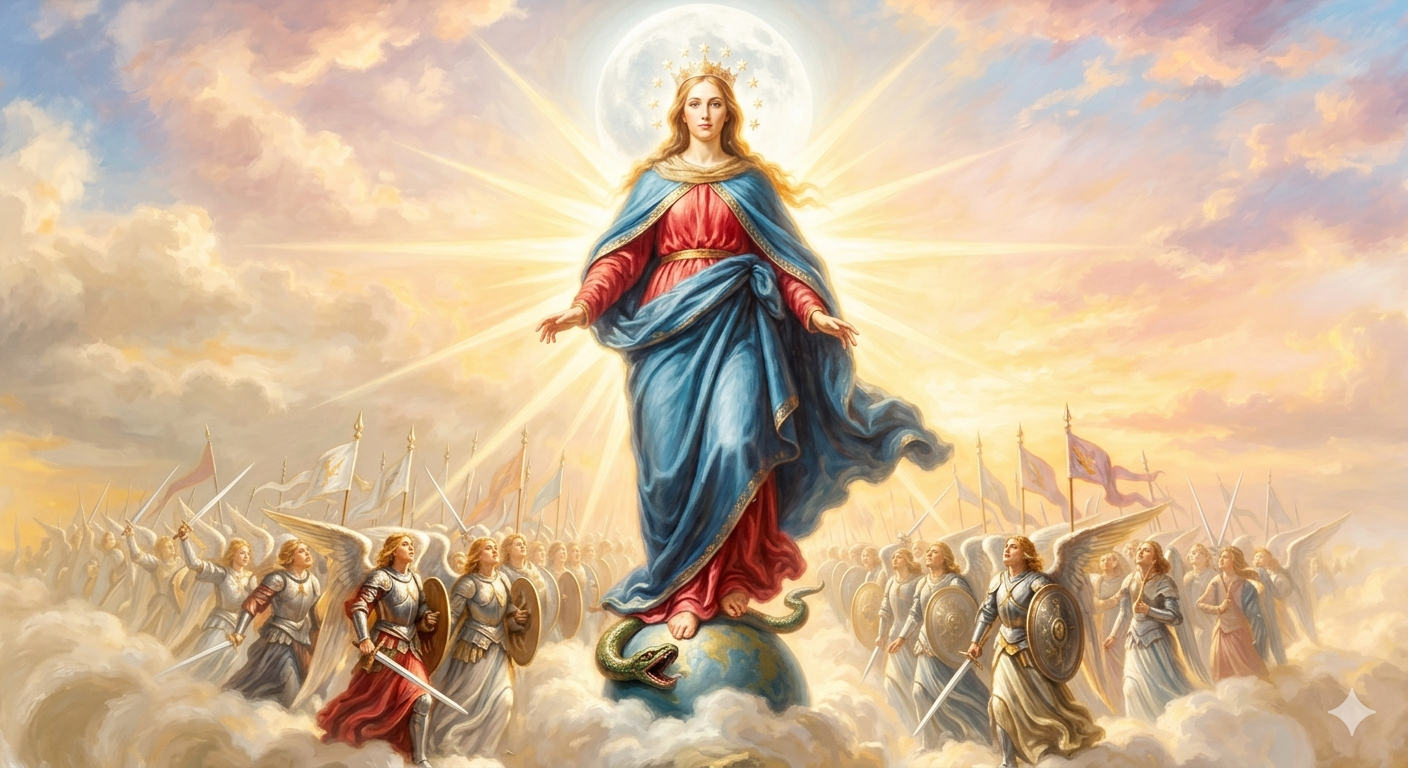
The image used in this essay was created using Google AI Image Creator.
What the Catena Legionis Teaches Us About Our Lady
Every day, in parish halls and quiet chapels around the world, members of the Legion of Mary stand together and ask this one question in their prayers. Active members go out into hospitals and nursing homes and do works that share our Lady. Meanwhile, Auxiliary members carry the Legion forward quietly, through prayer alone, from their own homes. In our home, it’s me, my wife, and my Mom who gather every night at 6:00 pm and ask this very question together. Every single member, active or auxiliary, asks the same question: Who is she that comes forth as the morning rising, fair as the moon, bright as the sun, terrible as an army set in battle array?”
This question didn’t start with the Legion of Mary. It comes straight from Scripture, found in Song of Songs 6:10: “Who is she that comes forth as the morning rising, fair as the moon, bright as the sun, terrible as an army set in battle array?” It’s worth repeating. I absolutely love this prayer. For centuries, the Catholic Church has read this verse as a direct reference to the Virgin Mary. When Frank Duff chose this verse for the Legion’s daily prayer, he wasn’t picking out a random scripture. He was picking a verse that Catholics had already been praying about Our Lady for a very long time.
Did you notice the four images in that verse: dawn, moon, sun, army. The first three are all about light. Morning light, moonlight, sunlight. They build on each other nicely, each one a little brighter and bolder than the last. And then, right when you expect a fourth kind of light, the verse turns a corner completely: terrible as an army set in battle array.
That word “terrible” needs to be explained, because we use it to mean something bad, like a terrible accident, or we are having a terrible day. But the word behind it, the old Latin word terribilis, comes from a verb that simply means “to frighten.” It didn’t mean bad or harmful. It meant something so overwhelming, so much bigger than you, that it stopped you in your tracks. Interestingly, that very same word is used in the Psalms to describe the works of God himself; his works are called “terrible,” meaning awe-inspiring beyond anything we can measure ourselves against. So, when this verse calls Mary “terrible as an army,” it isn’t handing her some lesser word. It’s handing her the same word Scripture already used for the power of God.
Frank Duff didn’t just borrow this verse and leave it as poetry. He put it right into the Legion’s own founding document, the Handbook, and he added something important. The Handbook doesn’t just say Mary is “terrible as an army set in battle array.” It says she is terrible in that way to Satan and his legionaries. That little phrase changes everything. It tells us plainly who is supposed to feel the fear here, not us, not the members standing in the room, but the enemy. The Handbook goes on to describe the Legion’s whole purpose as a kind of warfare, the ongoing battle the Church wages against evil in the world.
It helps to know a little about Frank Duff himself. He didn’t pick military language out of thin air. He built the Legion’s whole structure on the model of a Roman army; words like Praesidium, Legio, and Curia all come straight from Roman military ranks and units. And in his own life, before he founded the Legion, Frank had worked closely with Michael Collins, who led Ireland’s National Army during a real war. So, this wasn’t just a poetic metaphor to him. He had stood close to actual military command, and he shaped the Legion with that same sense of order, discipline, and purpose, but aimed entirely at that spiritual battle we endure, with Mary as our leader.
But here’s where the prayer takes a turn. Right after this antiphon, calling Mary terrible as an army, the Catena moves straight into the Magnificat, Mary’s own words, her own voice, sung out loud after the angel’s visit. And she doesn’t sound terrible at all, she sounds lowly. “He looks on his servant in her lowliness,” she says. She sings about God scattering the proud-hearted, casting the mighty from their thrones, raising up the lowly, filling the starving with good things, and sending the rich away empty.
At first, this might feel like a contradiction. How can she be an army in battle array in one breath, and a humble servant in the next? Just ponder on it a little longer, and it isn’t a contradiction at all; it’s the whole point. The Magnificat is what the army actually does. It’s the campaign. Mary’s strength was never about domination or force. Her strength was always about turning the world’s order upside down through humility and mercy, through lifting up the people everyone else overlooked. An army without the Magnificat would just be noise and threat, just as the Magnificat without the army image would just be a nice sentiment. Together, they say something much bigger: Mary’s gentleness is itself the offensive, and her lowliness is the weapon.
This is what it asks of a Legionary to pray this every single day, not just read it once. It’s easy to read a line like “terrible as an army” one time and feel a flash of awe, then move on and forget it by midday. But something different happens when you say these same words again and again, night after night, year after year. The words start to shape you, and you start to understand, slowly, that you are being invited to join that formation, not as a spectator admiring Mary from a distance, but as someone standing with her, letting her lead you the same way she led with her own lowliness and her own strength.
So, who is she? By now, the answer isn’t just a line from a poem anymore. She is the dawn breaking, the moon shining, the sun blazing, and she is also an army, standing firm, facing down every evil this world can offer, with nothing but love as her weapon. And the wonder of it all is this: she doesn’t stand alone. She leads us every single night, all over the world: ordinary people, mothers, fathers, grandparents, students, workers coming home tired from a long day, pray together and answer her call to join the ranks.
Some join that army on the front lines, going out into hospitals, nursing homes, and spreading the joy of Mary, giving their time and their energy directly to souls who need them. That kind of active membership is its own demanding, beautiful ministry, not for the faint of heart by any means, but deeply rewarding for those who can give it. Others join just as faithfully from home, as auxiliary members, holding up that same army through prayer alone, every single day, without fail, a quiet kind of strength that never shows up on the front page but never stops working either. Neither one is greater than the other. An army doesn’t march on its front line alone; it marches because every rank behind it holds firm too.
Maybe, reading this, something in you has stirred a little. Maybe you’re wondering whether there’s a Legion of Mary group meeting somewhere near you, in your own parish, in your own town, this week. That stirring is worth listening to. We are very blessed to have one right here at The Fatima Shrine. Join us if you can, but if you cannot, all it will take is a question at your parish office, or a conversation with your priest. Somewhere, right now, in a small room or a quiet home, this same question is being asked out loud: Who is she? And maybe it’s time you found out for yourself, right there, standing with her, next to her. Personally, for me, being part of the Legion of Mary in my life has deepened my love for our Lady, in ways that are often times hard to put into words.
Written by
James Dacey Jr., OFS
Auxiliary Member, Legion of Mary
at Our Lady of Fatima Shrine – Lewiston, NY